
Jun 18, 2026
Why Indian Cargo Gear Survey Is Mandatory for Vessels Arriving at Indian Ports And Why It Matters to Get It Done by a Competent Authority
Technical Guide • Updated September 2026
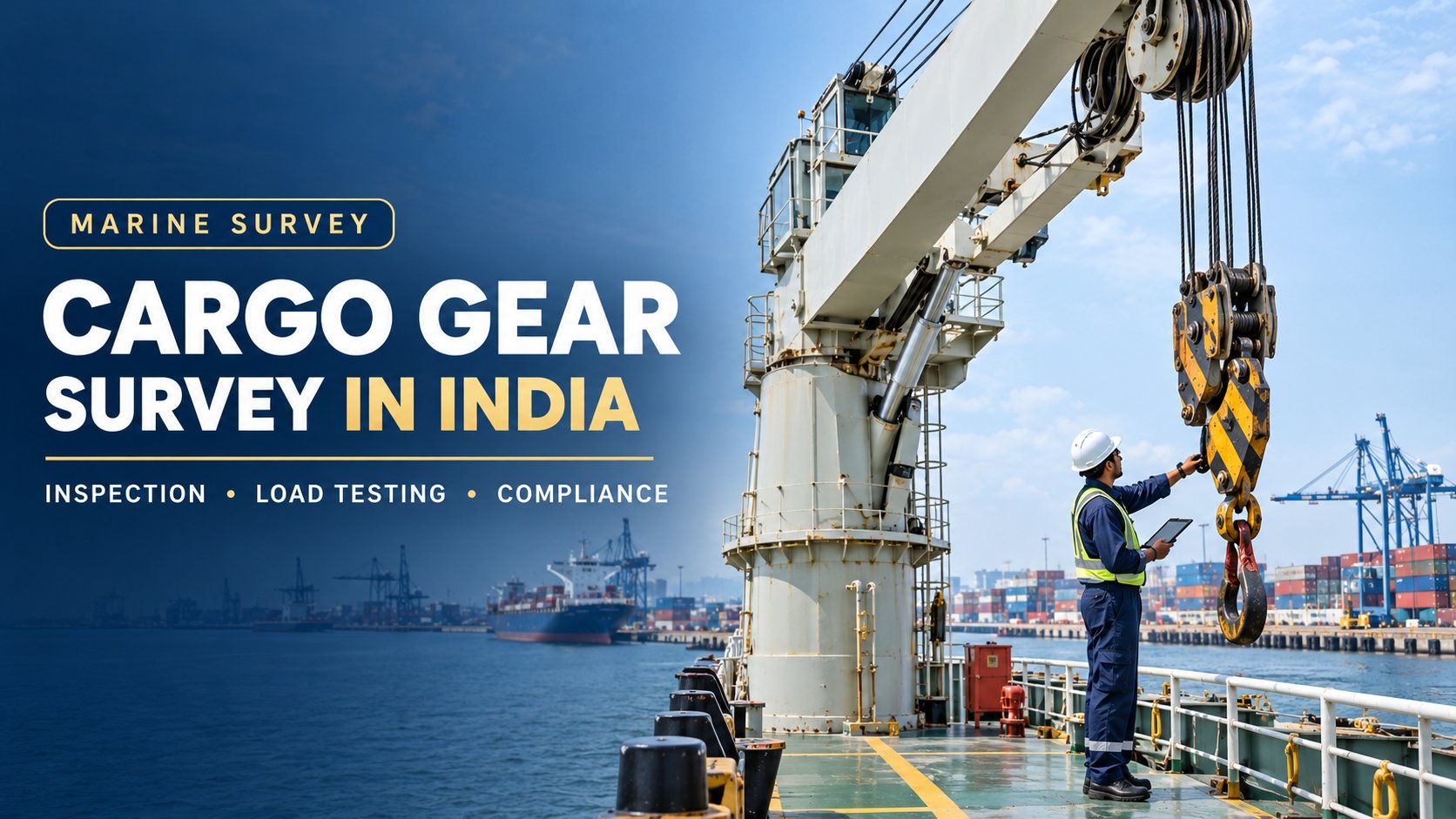
Cargo Gear Survey in India
Requirements • Inspection • Load Testing • Compliance at Indian Ports
SOLAS II-1/3-13
DGS MSN 02/2026
ILO Convention No. 152
By Solanki Ship Care
In This Guide
What Is a Cargo Gear Survey
Requirements in India
Equipment Covered
Survey vs Inspection vs Load Test
How Survey Is Conducted
Checklist
FAQ
What Is a Cargo Gear Survey?
A Cargo Gear Survey is a systematic inspection, examination and, where required, testing of a vessel's lifting appliances and associated loose gear to verify that the equipment is safe and suitable for its intended use.
Cargo handling equipment such as ship cranes, cargo derricks, winches, hooks, wire ropes, shackles, blocks, sheaves, lifting beams, slings and other loose gear operates under significant loads. Defects in structural components, wire ropes, brakes, hooks, sheaves, foundations or lifting accessories can create serious risks to crew, dock workers, cargo and the vessel.
A proper cargo gear survey goes beyond checking whether a certificate exists. It involves assessing the condition, identification, safe working load (SWL), documentation, testing history and operational safety of the relevant equipment.
⚠ Failure of Lifting Appliances or Loose Gear Can Result In
►Serious injury or loss of life
►Damage to cargo
►Suspension of cargo operations
►Operational delays
►Off-hire exposure
►Regulatory non-compliance
Cargo Gear Survey Requirements in India
Cargo gear requirements in India need to be understood in the context of the vessel, its flag, the lifting equipment installed, its intended use, applicable statutory requirements, and the requirements of the relevant port or terminal.
Regulatory Framework
SOLAS II-1/3-13
In force from 1 January 2026. Covers design, construction, operation, inspection, testing and maintenance of onboard lifting appliances and anchor-handling winches.
DGS MSN No. 02 of 2026
Issued by Directorate General of Shipping, India. Addresses implementation of SOLAS II-1/3-13 for Indian-flag vessels.
IMO Circulars
MSC.1/Circ.1663 — Lifting appliances | MSC.1/Circ.1662 — Anchor-handling winches
ILO Convention No. 152
International dock-work safety. Provides for periodic thorough examination at least once every 12 months.
⚠ Important: Not Every Vessel Has the Same Requirement
Cargo gear requirements should not be treated as a blanket rule. The applicable requirements can depend on:
●Vessel flag
●Type and capacity of lifting appliance
●Equipment installation date
●Applicable SOLAS requirements
●Port or terminal requirements
●Cargo operation being performed
What Equipment Is Covered?
Depending on the scope of the survey, cargo gear inspection may cover the vessel's lifting appliances and associated loose gear. DGS MSN 02/2026 specifically identifies the applicable equipment categories.
⬆
Lifting Appliances
✓Shipboard & deck cargo cranes
✓Cargo derricks
✓Cargo winches
✓Provision and stores cranes
✓Engine-room cranes
✓Hose-handling cranes
✓Hatch-cover handling appliances
✓Anchor-handling winches (where applicable)
🔗
Associated Loose Gear
✓Hooks and shackles
✓Swivels and chains
✓Wire-rope slings
✓Blocks and sheaves
✓Lifting beams and frames
✓Cargo grabs
✓Connecting devices
✓Other detachable lifting accessories
Survey vs Inspection vs Load Testing
These terms are sometimes used interchangeably, but they are not the same activity. Understanding the distinction is important for planning the correct scope.
How a Cargo Gear Survey Is Conducted
The exact scope depends on the equipment and applicable requirements. A typical survey may include the following stages.
1
Review of Existing Documentation
Before physical examination, the surveyor may review: equipment certificates, previous examination reports, load-test records, SWL information, maintenance records, repair records, Register of Lifting Appliances and Cargo-Handling Gear, loose-gear certificates, and rigging plans.
2
Identification of Lifting Equipment
Each applicable lifting appliance and item of loose gear is positively identified — equipment ID, SWL, manufacturer, serial number, location, applicable test information and certification status. Certified appliances are recorded in the Register of Ship's Lifting Appliances and Cargo Handling Gear.
3
Structural and Mechanical Examination
Structure
Boom, pedestal, slewing structure, foundations, pins, bearings, welded areas, structural connections
Wire Rope
Broken wires, corrosion, kinking, crushing, bird-caging, diameter reduction, end connections
Hooks & Gear
Hook deformation, cracks, wear, safety latches, shackles, pins, chains, slings, blocks, sheaves
Safety Systems
Brakes, limit switches, emergency stops, overload protection, hydraulic systems, control systems
4
Load Testing (Where Required)
A specified test load is applied under controlled conditions. Pre-test considerations must include: equipment SWL, applicable test-load requirements, test weights or calibrated equipment, vessel stability, deck strength, weather, safety exclusion zones and emergency procedures.
✓
Certification and Record Update
Certificates of test and thorough examination, load-test reports and updated Register of Lifting Appliances are completed. Deficiencies are documented and recommendations issued for rectification before equipment is returned to service.
What Happens If Cargo Gear Has a Defect?
A failed or defective component should not be overlooked because cargo operations are commercially urgent. DGS 2026 guidance specifically addresses inoperative lifting appliances — preventing their operation until necessary repairs, testing and thorough examination have been completed.
1
Identify and isolate the affected equipment
2
Prevent its use until safety concern is resolved
3
Carry out necessary repairs or replacement
4
Perform required testing after repair
5
Conduct thorough examination post-repair
✓
Update records & obtain approval before returning to service
How Solanki Ship Care Supports Cargo Gear Survey
At Solanki Ship Care, our marine survey support helps coordinate the inspection and testing process at Indian ports, involving coordination between shipowner, vessel manager, master, technical team, surveyor, testing personnel and port stakeholders.
✓
Cargo gear survey coordination
✓
Lifting appliance inspection coordination
✓
Cargo crane inspection
✓
Load testing coordination
✓
Loose gear & wire rope inspection
✓
Documentation review
✓
Surveyor & port-side coordination
✓
Report & certificate coordination
Cargo Gear Survey Pre-Arrival Checklist
Waiting until the vessel is alongside can create unnecessary operational risk. A pre-arrival review gives time to identify expired certificates, documentation gaps, equipment deficiencies and testing requirements before the vessel reaches port.
| Pre-Survey Check | Status |
|---|---|
| Vessel & Equipment Details | |
| Vessel name, IMO number, flag and port of call confirmed | ☐ |
| Current SWL information for all lifting appliances available | ☐ |
| Documentation | |
| Cargo gear register available onboard | ☐ |
| Previous examination records and certificates available | ☐ |
| Load-test records available | ☐ |
| Loose-gear certificates available | ☐ |
| Physical Condition | |
| Wire ropes visually checked for broken wires, corrosion, deformation | ☐ |
| Hooks and shackles inspected for wear, distortion and safety latches | ☐ |
| Brakes and safety devices checked | ☐ |
| Crane/derrick structure inspected for corrosion and deformation | ☐ |
| Survey Preparation | |
| Deficiencies identified and rectified before survey | ☐ |
| Test equipment arranged where load testing is required | ☐ |
| Port/terminal requirements confirmed | ☐ |
| Survey attendance coordinated before cargo operation | ☐ |
Frequently Asked Questions
Is cargo gear survey mandatory for every vessel arriving at an Indian port? +
Not as a blanket rule. The applicable requirement depends on the vessel, flag, lifting equipment, operation and relevant regulatory, port, terminal and recognized-organization requirements. For Indian-flag vessels, DGS Merchant Shipping Notice No. 02 of 2026 addresses the implementation of SOLAS II-1/3-13 for applicable onboard lifting appliances and anchor-handling winches.
What is checked during a cargo gear survey? +
Depending on the scope, the examination may cover cranes, derricks, winches, wire ropes, hooks, shackles, blocks, sheaves, lifting beams, slings, structural components, brakes, safety devices, SWL markings and relevant documentation. The exact examination scope always follows the applicable equipment, manufacturer’s requirements and regulatory criteria.
What is the difference between cargo gear inspection and thorough examination? +
An inspection is generally a routine visual assessment to identify obvious defects. A thorough examination is a more detailed assessment by a competent person intended to determine whether the equipment remains safe for continued use — which may include additional measurement or examination methods beyond visual inspection alone.
Is load testing the same as a cargo gear survey? +
No. Load testing is one component of cargo gear verification where required. A cargo gear survey may also involve documentation review, visual examination, structural and mechanical checks, and assessment of loose gear — load testing is only one part of the overall process when applicable.
How often does cargo gear need to be load tested? +
Under DGS 2026 requirements applicable to SOLAS II-1/3-13 lifting appliances, applicable lifting appliances are to be retested at least once every five years, with additional testing requirements after certain installations, repairs or major modifications. The applicable interval depends on the equipment and regulatory regime.
How often should cargo gear be thoroughly examined? +
ILO Convention No. 152 provides for periodic thorough examination by a competent person at least once every 12 months. For a particular vessel, the applicable flag, class/RO, statutory and port requirements should be confirmed as intervals may differ.
What documents are required for a cargo gear survey? +
Documents may include the cargo gear register, previous certificates, test records, SWL information, loose-gear certificates, maintenance records, repair records, rigging plans, block lists and other manufacturer or statutory documentation. The DGS 2026 notice states certified lifting appliances should be recorded in the Register of Ship’s Lifting Appliances and Cargo Handling Gear together with the Certificate of Test and Thorough Examination.
Can cargo gear survey be arranged at Indian ports? +
Yes. Cargo gear survey and related marine survey attendance can be coordinated at Indian ports, subject to surveyor availability and the requirements applicable to the vessel and operation. Solanki Ship Care provides marine survey coordination and ship-support services at Indian ports.
What happens if cargo gear fails the examination? +
The affected equipment may need to be taken out of service until the defect is rectified. Depending on the defect, repair, replacement, retesting and further examination may be required before the equipment can safely return to service. DGS 2026 guidance requires preventing operation of inoperative lifting appliances until necessary repairs, testing and examination are completed.
Why should cargo gear survey be arranged before vessel arrival? +
Pre-arrival planning provides time to review documentation, identify potential deficiencies, arrange testing equipment and coordinate the appropriate competent person or recognized organization. This can reduce the risk of avoidable delays during cargo operations — particularly where cargo operations are scheduled immediately after arrival.
“The objective is not simply to obtain a certificate — it is to ensure that lifting appliances and loose gear are properly identified, maintained, examined, tested and documented.”
With the implementation of SOLAS II-1/3-13 from 1 January 2026, the regulatory focus on onboard lifting appliances has become even more significant. Planning cargo gear inspection and testing in advance can help vessels avoid preventable operational problems and ensure that cargo-handling equipment is ready for safe use.
Need a Cargo Gear Survey at an Indian Port?
Contact Solanki Ship Care
Provide your vessel name, IMO number, port and required survey scope.
We will coordinate the survey arrangement at your Indian port of call.
www.solankiship.com
Smart Maritime Support ✓