
Ship Steel Repair – DP Test, Hose Test & Chalk Test | Solanki Ship Care
Ship Steel Repair
Steel Plate Renewal • Welding • DP Test • Hose Test • Chalk Test
Overview
teel structures onboard commercial vessels operate continuously in demanding marine environments. Corrosion, mechanical wear, repeated loading, vibration and exposure to moisture can gradually affect steel plating, supporting structures and hatch-related components. Solanki Ship Care recently completed a ship steel repair job involving removal and renewal of an affected steel plate section, followed by welding, inspection and hatch leakage testing.
After completion of the repair, the work was presented to the vessel’s staff and successfully verified through a Dye Penetrant Test (DP Test), hose test and chalk test. The complete job was finished to the satisfaction of the ship’s staff.
NDT
Dye Penetrant
Weld Inspection
HOSE
Hose Test
Leakage Check
CHALK
Chalk Test
Seal Contact
✓
All Tests Passed
Ship Staff Satisfied
The Repair Process
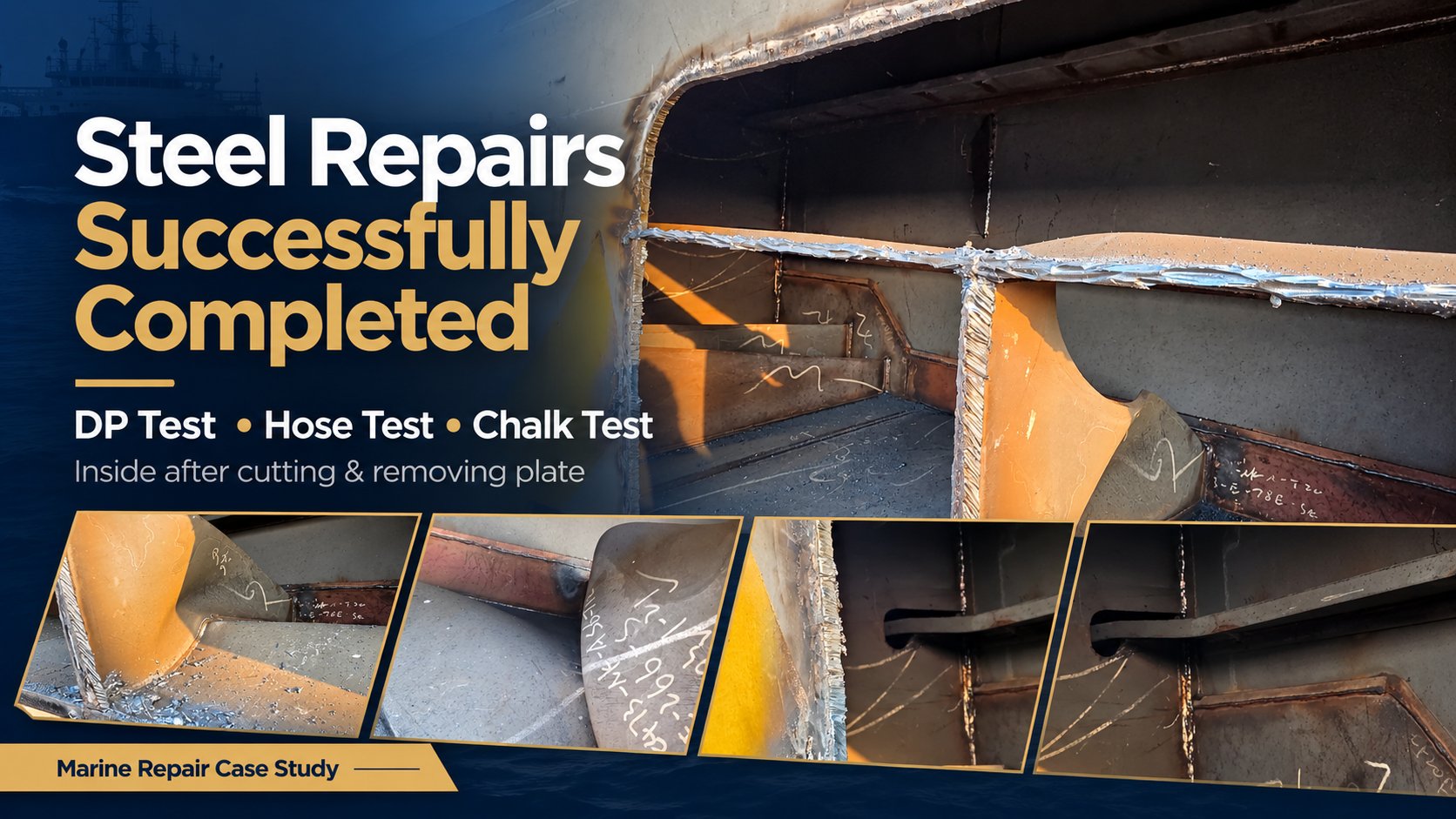
Steel Plate Cutting and Removal
The repair process began with access to the affected steel structure and removal of the existing plate section. After cutting and removing the original steel plate, the repair team had access to the surrounding supporting members and the area requiring renewal.
Note: Proper preparation is critical — the quality of the final weld depends not only on welding but also on accurate cutting, fitting, alignment and preparation of the surrounding steel.
Steel Renewal and Fitting
Following removal, the area was prepared for steel renewal. The replacement steel was positioned and fitted into the existing structure, accounting for the existing structural arrangement, accessibility and alignment of the surrounding members. The objective was not simply to cover the damaged area but to carry out a properly fitted repair that integrates with the vessel’s existing steel structure.
Welding Completed
Welding was completed around the repair area. Once the welding work was finished, the repaired area was prepared for inspection and post-repair testing.
Post-Repair Inspection & Testing
Three separate verification steps were performed — Dye Penetrant Test (DP Test) on the completed welds, hose test for leakage checking, and chalk test for sealing contact. All three stages were completed successfully to the satisfaction of the vessel’s staff.
Post-Repair Verification Tests
Completing the welding is only one part of a professional marine steel repair. Three distinct verification stages were performed before the job was handed over to ship’s staff.
Dye Penetrant Test
A Dye Penetrant Test (DP test / liquid penetrant test) was carried out on the completed welds. Dye penetrant inspection is a recognised form of non-destructive testing used to detect surface-breaking imperfections in metallic welds.
Hose Test
Because the repair was associated with an area where hatch tightness was important, a hose test was carried out to check for leakage. The hose test is widely used in the marine industry to assess hatch-cover weathertightness.
Chalk Test
A chalk test was carried out to check contact between the sealing rubber and the compression bar. Chalk is applied to the relevant contact surface before the hatch is closed. When reopened, transferred chalk marks are inspected.
Why Post-Repair Testing Is Important
Post-repair inspection provides confidence that both the physical repair and the operational function of the repaired area have been checked. Each test in this job served a distinct purpose.
Marine Steel Repair — More Than Welding
A successful ship repair may require several stages beyond cutting and welding a replacement plate.
Ship Steel Repair Services by Solanki Ship Care
Solanki Ship Care supports vessels with marine steel repair, fabrication, welding and onboard technical repair services across Indian ports.
Inspect. Repair. Test. Verify.
The steel section was renewed, welding was completed, welds were checked by DP testing, hatch sealing was checked by chalk testing, and leakage performance was verified through a hose test — before the job was successfully handed over to the ship’s staff.
Frequently Asked Questions
What is a Dye Penetrant Test (DP Test) in ship repair? +
A Dye Penetrant Test (also called DP test or liquid penetrant test) is a recognised non-destructive testing method used to detect surface-breaking imperfections in metallic welds. A penetrant material is applied to the cleaned weld surface, allowed to enter any surface discontinuities, and then a developer is applied to reveal relevant indications. ISO 23277 specifically covers acceptance levels for indications detected by penetrant testing of metallic welds. The key advantage is that the weld quality can be assessed without damaging the repaired component.
What is a hose test for hatch covers? +
A hose test is a widely used marine industry method for assessing hatch-cover weathertightness. The hatch is properly closed and secured, then pressurised water is directed toward the sealing areas while the internal area is checked for signs of leakage. It is considered a more rigorous method than routine visual inspection and is an established way to evaluate hatch-cover sealing effectiveness following repairs or maintenance.
What does a chalk test check on a hatch cover? +
A chalk test checks contact between the hatch sealing rubber and the compression bar. Chalk is applied to the contact surface before the hatch is closed. When the hatch is reopened, the transferred chalk mark is inspected — missing or interrupted contact marks can indicate areas where the seal is not making proper contact. Importantly, chalk testing alone should not be treated as confirmation of full weathertightness, as it does not measure actual compression of the sealing rubber. It is most useful when combined with a hose test.
Why is post-weld testing important in ship steel repair? +
Post-repair testing provides confidence that both the physical repair (quality of the weld) and the operational function of the repaired area (sealing and weathertightness) have been properly checked. Completing welding alone is not sufficient — weld inspection, sealing assessment and functional leakage testing together create a more complete post-repair verification process before the job is handed over.
Does Solanki Ship Care provide ship steel repair services at Indian ports? +
Yes. Solanki Ship Care supports vessels with marine steel repair, fabrication, welding and onboard technical repair services across Indian ports. Services include steel plate renewal, hatch cover steel repairs, deck steel repairs, marine welding, structural fabrication, pipe and support fabrication, weld inspection coordination, hatch leakage testing and technical repair support.
Job Snapshot
| Detail | Information |
|---|---|
| Repair Type | Ship Steel Plate Renewal & Welding |
| Post-Repair Tests | DP Test (NDT), Hose Test, Chalk Test |
| Testing Standard | ISO 23277 (DP Test) • Marine Industry Practice (Hose & Chalk) |
| Area Repaired | Hatch-related steel plate section |
| Result | All Tests Passed — Accepted by Ship Staff |
| Performed By | Solanki Ship Care |
Ship Steel Repair • Welding • Hatch Cover Repairs • Indian Ports
Ready to Support Your Vessel at Indian Ports
Ship Repairs • Marine Steel Repairs • Welding & Fabrication • Marine Technical Services • Ship Chandlers
www.solankiship.com